
Fissures
The largest country in South America came within two points of firing the man it had. Then it rehired him.
Whit Boone - Avenues
History. What resistance actually costs.
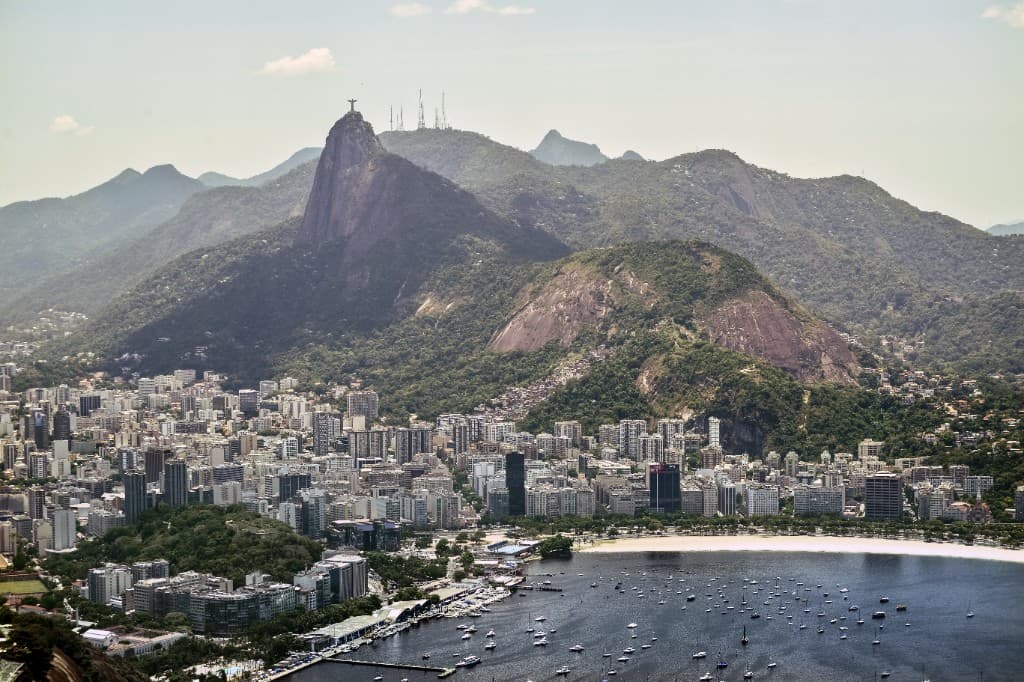
Rio, Toward Corcovado
lhccoutinho (Pixabay)
The largest country in South America came within two points of firing the man it had. Then it rehired him.
The Count
Sunday, Brazil chose a president. The country is larger than the lower forty-eight states. More than two hundred million people live there. It sells the world a great share of its soybeans, its beef, and its iron ore. Most Americans slept through the count. The count is the fact.
The winner is Luiz Inácio Lula da Silva. He is seventy-nine. He was a lathe operator in the automobile plants outside São Paulo, and he lost a finger in a press. In the late 1970s, when the generals still held Brazil, he led the metalworkers' strikes. In 1980 he helped found the Workers' Party, the party of the Brazilian left, built by those unions and by Catholics who wanted the Holy Roman Catholic Church on the side of the poor. Brazilians call him Lula. He was president from 2003 through 2010. He went to prison on corruption charges. In 2021 the Supreme Court threw those convictions out. He won the office back in 2022. On Sunday he won it again. This will be his fourth time in the chair. The Senate's news service says he is to be sworn in on 5 January 2027.
He took 51.79 percent of the valid votes, a little over 64 million. The man he beat took 48.21 percent, a little under 60 million.
A valid vote, in Brazil, is a vote for a candidate. Blank ballots and spoiled ballots are set aside, and the percentage is taken from what remains. About 159 million citizens were eligible. About one in five stayed home. Fewer stayed home than in the first round, three weeks earlier.
The man he beat is Flávio Bolsonaro, a senator from the state of Rio de Janeiro. His party is the Liberal Party, which in Brazil is the vehicle of his family, not a copy of any liberal party an American would recognize. His father is Jair Bolsonaro, the right-wing president Lula defeated in 2022. Jair governed from 2019 through 2022. He has been ruled ineligible to run until 2030. He is serving a sentence of twenty-seven years for plotting to overturn that defeat. In March a Supreme Court justice, Alexandre de Moraes, allowed him to serve it at home for reasons of health, with a monitor on his ankle. Americans who know one Brazilian name usually know the father. The son carried the name because the father cannot.
Brazil holds a second vote when the first one is split. A candidate needs more than half of the valid votes to win outright. On 4 October nobody did. Flávio led that day, 47 percent to Lula's 45. The top two met again on 25 October. No one, since Brazil began electing presidents by popular vote again after the generals, has trailed in that first vote and then won the second. The Senate's news service said so. Lula just did.
The Last Two Hours
The polls were supposed to close at five in the afternoon, Brasília time. Brazil votes on electronic machines. There is no paper stack in a school gym for the public to watch. The machine records the vote. The election court totals it.
Both campaigns asked for more time, and they did not ask it for the same places. Lula's campaign told the courts that public buses had failed in cities that lean his way. São Paulo and Salvador were among them. The request covered at least nine states. Flávio's campaign asked for two extra hours in towns hit by heavy rain, in the south and in parts of the southeast, where he is strong.
The order that moved the country was on Lula's paper. Cristiano Zanin is a justice of the Supreme Federal Court, Brazil's highest constitutional court, which is not the election court. He was Lula's lawyer in the criminal cases. Lula named him to that court in 2023. On Sunday the bus petition reached the court around half past four. Minutes before five, Zanin ordered every polling place kept open until seven. He later said the order applied only where the machines were still open. A machine already closed was not reopened. Some cities voted longer than others.
The election court is a separate body. Its name is the Tribunal Superior Eleitoral. It finishes a Brazilian presidential count and declares the winner. Its president, Kassio Nunes Marques, adopted Zanin's order, limited it to machines still open, and paused a totaling that had already begun. When the count was done, the court declared Lula elected. Marques said the extra time had not compromised the election.
Flávio says a day on which some cities voted longer than others cannot be accepted. He said it was impossible to recognize the result in the way the day had been run. He said he would ask to have the election annulled. He was quieter about his own campaign's request for the same kind of extra hour.
I will not invent what those two hours changed. Nobody has put a paper on the table that counts the votes cast after five and shows they supplied the margin. Lula's lead was a little over four million votes. The extra time is the reason the loser says he will never know. A finished count and a challenge to the clock are both Monday's facts. A challenge is not yet an annulment.
The Map Around Him
For twenty years American readers were given a nickname for a run of elections. Reporters called it the Pink Tide. It meant left-wing presidents, beginning with Hugo Chávez in Venezuela in 1998 and Lula in Brazil in 2002. Pink meant a lighter red than the old Communist parties. It was a headline, not one government.
The governments were different from one another. They shared a habit. The national government owned the oil, the natural gas, and the mines, or kept the block of shares that let it give the orders. The president then told the country he had done it for the poor.
That habit has been breaking up, country by country, for reasons the campaigns themselves named. Crime. Prices. Distrust of the people already in the chairs. Sunday did not start the breakup. Sunday is the largest country refusing to join it.
Argentina elected Javier Milei in November 2023. He is an economist who campaigned against an inflation that had eaten the peso, and against the Peronist machine. Peronism is the movement named for Juan Perón, the strongman of the 1940s and 1950s. It has been Argentina's dominant politics for eighty years, left version and right version, with the state near the center. Milei arrived promising to cut it.
Chile swore in José Antonio Kast in March of this year. In a December runoff he beat Jeannette Jara with just over 58 percent of the valid vote. He replaced Gabriel Boric, who had taken office in 2022 as the young face of the Chilean left.
Bolivia swore in Rodrigo Paz Pereira on 8 November 2025, of the Christian Democratic Party, after two decades of the Movement Toward Socialism, the party Evo Morales built from the coca growers and the gas.
Peru swore in Keiko Fujimori on 28 July, the country's independence day. She won a June runoff by a shade over half the valid vote. She is the daughter of Alberto Fujimori, the president of the 1990s who broke a hyperinflation and a guerrilla war and was later imprisoned for corruption and for crimes against human rights.
Colombia swore in Abelardo de la Espriella on 7 August. He is a lawyer of the Colombian right. He replaced Gustavo Petro, the first man of the left to win Colombia's presidency.
Ecuador reelected Daniel Noboa this past spring, a young president from a banana-export family who has governed on security. Paraguay has been under Santiago Peña since 2023. Peña belongs to the Colorado Party, the old ruling party, which was never part of the left-wing wave.
Uruguay is the exception still on the left, and it is not a ruin. Yamandú Orsi, of the Broad Front, took office in 2025. Uruguay has pasture, institutions, and a social-democratic habit. Treating it as the same article as Caracas is how maps get stupid.
Venezuela is the ruin of the original wave. Chávez, and then Nicolás Maduro, used the state oil company as a treasury. On 3 January the United States seized Maduro in Caracas and flew him to New York. On 5 January his vice president, Delcy Rodríguez, was sworn in. She comes from the same movement. A defendant on a plane is a fact. A free well is a different fact.
Put the names on one page and Sunday looks different. Argentina, Chile, Bolivia, Peru, and Colombia have already changed hands. The country that anchors the continent rehired the Workers' Party. The long argument for why that kind of leadership was ever likely is in the other article. This one is the day the largest piece stayed.
The Cracks Already In the Country
The cracks are not a theory about the year 1517. They are already in the census and in the classrooms.
Brazil's census bureau, the Institute of Geography and Statistics, released the 2022 count of religion in June 2025. Among Brazilians aged ten and older, 56.7 percent called themselves Catholic. That is about 100 million people. Evangelicals were 26.9 percent, about 47 million, up from 21.7 percent in 2010. People who claimed no religion were 9.3 percent. The evangelical gain was real, and it was slower than the gain between 2000 and 2010. Forty-seven million is not a majority. Polls through this decade have shown evangelical voters preferring Jair Bolsonaro to Lula by a wide margin. Lula won the country anyway. A church can grow for fifty years and still lose an election. Sunday is that proof.
Inside the Catholic rooms the teaching has moved, and the other article has the documents. Here the fact is local. Many Brazilian Catholics are now taught that the Bible is the Word of God and that a person is saved by faith, not by having a name on the parish roll. The Holy Roman Catholic Church has not published a rule that the Bible outranks the pope. A large number of its people in this country are teaching those sentences anyway. Politicians have to speak to both crowds. Speaking was not enough to move two points.
What the Cargo Still Does
The vote did not change the buyer.
Santos, the port Americans have heard of, is not on the Gulf. It is on the South Atlantic, on the coast of São Paulo state. It moves containers, coffee, sugar, and a great deal of soy. A ship from Santos bound for Houston takes the Atlantic and the Caribbean and is gone for weeks. A ship bound for China goes the other way, south and around Africa, and is gone for more than a month. The iron does not mainly leave from Santos. The great ore province is Carajás, in the state of Pará. The company is Vale. The ore goes by rail to the terminal at São Luís, in Maranhão, and leaves from there. China has been the customer.
China did not wait for Sunday. In November 2024 Xi Jinping inaugurated a deep-water port at Chancay, on the Pacific coast of Peru, north of Lima. The operator is COSCO, a Chinese state shipping company, which holds 60 percent. The first phase was a Chinese investment of 1.3 billion dollars. In May 2025 Brazil's planning minister, Simone Tebet, said her government was in talks with a Chinese state railway company about a line from that port to Brazilian territory. A talk is not a railroad. A railroad, if it is built, aims the soy and the ore at the Pacific buyer. The political architecture sits on the land before any ship leaves.
The oil company has a name. Petrobras is controlled by the federal government. On the company's own list, dated 31 January 2025, the Union held a little over half of the voting shares directly. Private shareholders own the rest, and the stock trades in São Paulo and in New York. It is still the state's oil company. On 5 January it will still be the state's oil company. Lula offered Mexico, in March, a partnership between Petrobras and Mexico's state company on deep water. That offer is a conversation between two governments that did not lose on Sunday.
Senator Bernie Sanders of Vermont congratulated Lula on the reelection and said he had stood up for Brazilian workers and for democracy and would go on doing so. That is the American applause. It is not a change in the owner of the ore, or in the customer, or in the voting stock.
Almost
Almost is a number. Four million votes. Two points. A first round the son was winning. A clock moved in the last hour by the winner's former lawyer. A loser who wants the count thrown out and has a grievance the court has not yet answered.
Almost is not a turn. The neighbors have been hiring different men, for crime and for prices, and a new president is not a new economy on the Monday after. Brazil had the timetable. It used the timetable. The Workers' Party keeps the chair. The evangelical churches keep their millions. The Bible classes keep teaching. The ore keeps leaving São Luís for whoever pays and whoever shortens the water.
Continuity is a bet. On Sunday, in the largest country on that continent, the bet paid the man already in the chair. The fissures are open. The building did not fall.
— Whit Boone